Preschool Clothes in Sweden: An Autumn & Winter Guide for Kids
What should your child wear to preschool in Sweden? Layering basics, rainwear vs shell clothes, a temperature cheat sheet and what to pack — a practical autumn and winter clothing guide for parents.
If you have ever stood by the front door on a Swedish morning thinking — "It's 7°C… is that fleece weather? Rainwear? Winter overall? All three?" — you are definitely not alone.
Dressing a child for preschool in Sweden can feel like learning a completely new system. The weather changes quickly, children spend a lot of time moving outdoors, and what feels cold while you are standing at the bus stop may feel very different to a child who has been running around the playground for 20 minutes.
The easiest way to think about it is: temperature + weather + activity level + your child. There is no perfect outfit for every child at every temperature. 1177 recommends adapting clothing to the weather, the child's age and how active they are.*1
The quick "what should they wear?" guide
Use this as a starting point, not a strict rule.
Temperature guide
Pick today's temperature and get an outfit suggestion — a starting point, not a rule. Wind, rain, how active the child is and the child themselves matter more than the number.
Feel the back of the neck: warm and dry means the child is dressed about right.
The 0–18°C ranges above are based on Bergans' temperature and activity guide for children.*2 For colder winter weather, 1177 recommends layering and adapting clothing according to how much the child moves.*1
The easiest trick: think in three layers
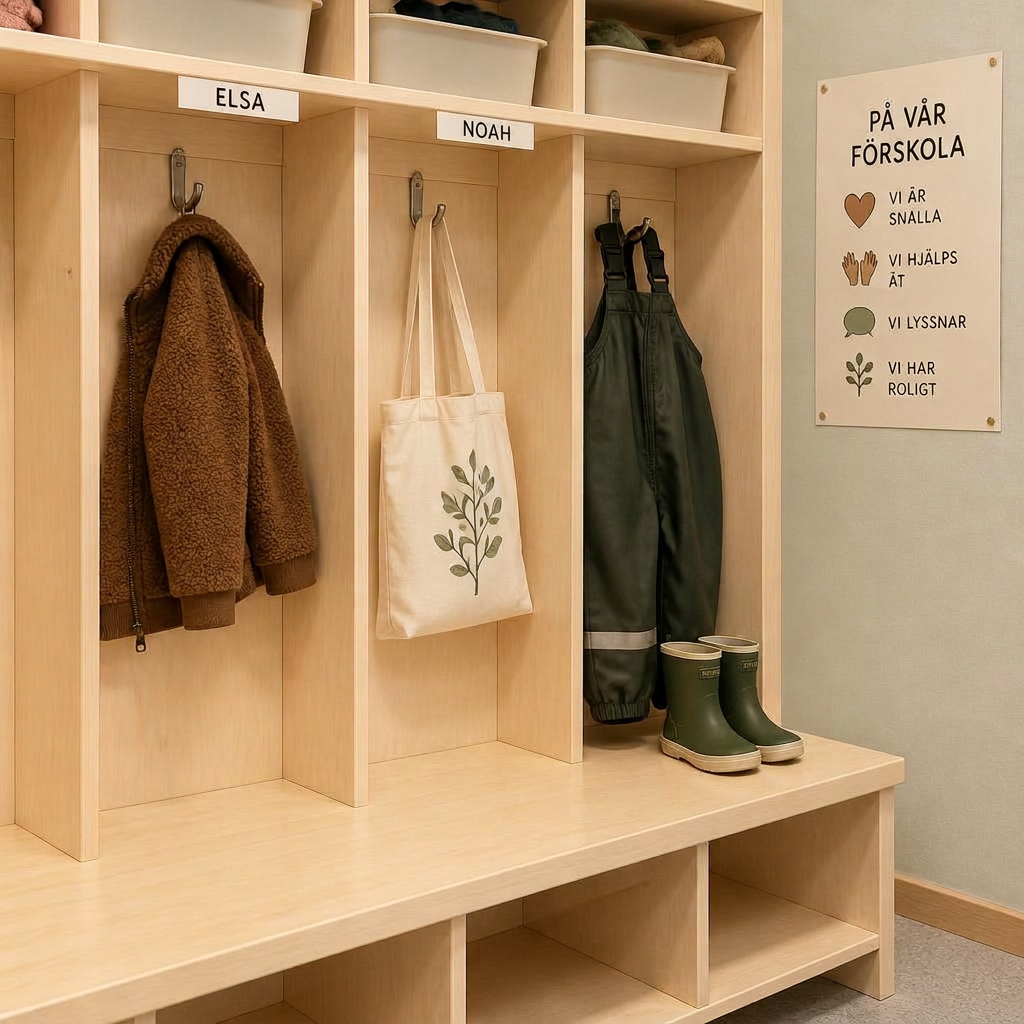
You do not need twenty different types of outdoor clothing. Think: 1. Keep dry → 2. Keep warm → 3. Keep the weather out.
1177 recommends several thinner layers rather than one very thick layer, because layers can be added or removed as needed.*1 Bergans uses the same three-layer principle in its children's outdoor clothing guidance.*2
And remember: an active child may need fewer layers than a child who is sitting or playing quietly. 1177 specifically recommends taking activity level into account.*1
Rainwear or shell clothes?
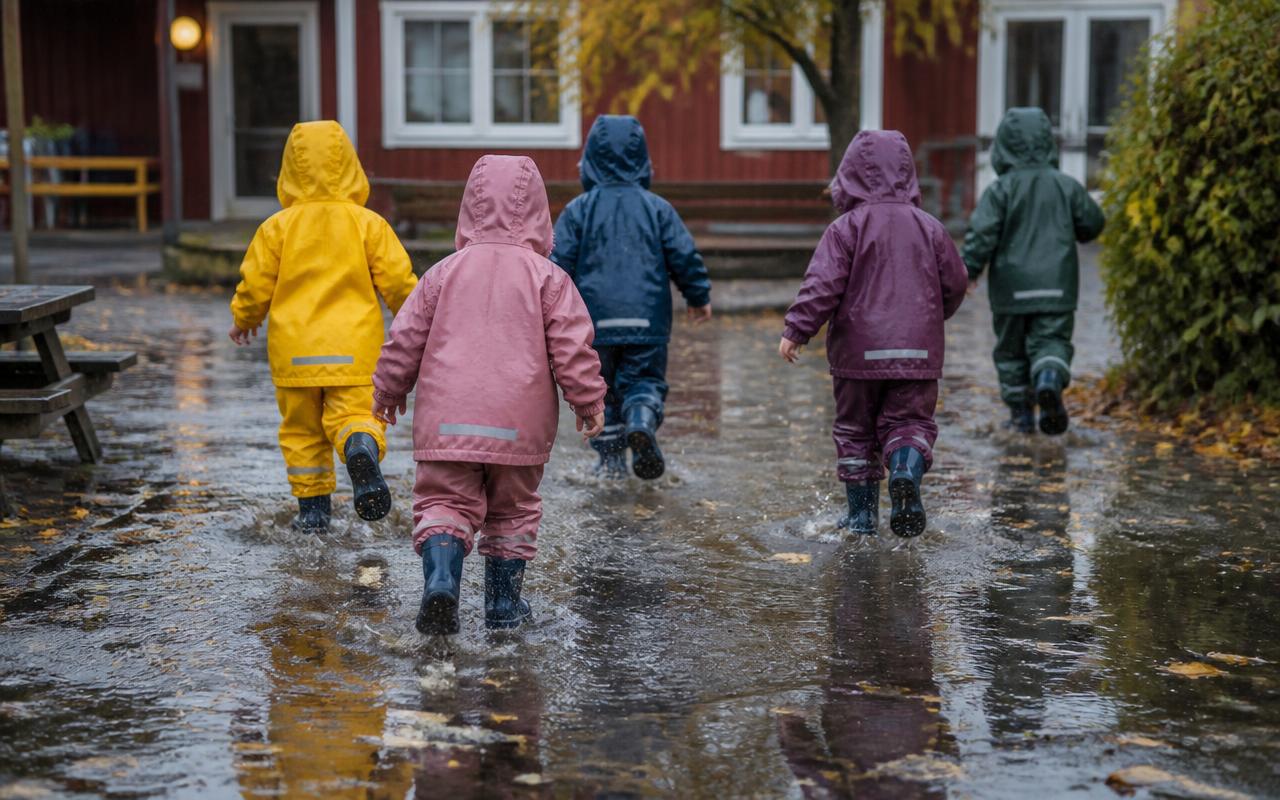
Welcome to one of Sweden's classic preschool-parent questions. You will probably hear two words very quickly:
- Rainwear / galon — great for wet, muddy, puddle-heavy days.
- Shell clothes / skalkläder — designed to protect from wind and rain while allowing more flexibility for active play.
You do not necessarily have to choose one forever. A practical preschool wardrobe can include shell clothing for everyday changing weather and rainwear for seriously wet and muddy days.
The most useful question is not "which one is best?" — it is "what does my child's preschool actually do outside?" Ask the staff. A group that regularly spends hours in forests and parks may have different needs from a group mainly using a sheltered preschool yard.
And then winter arrives…
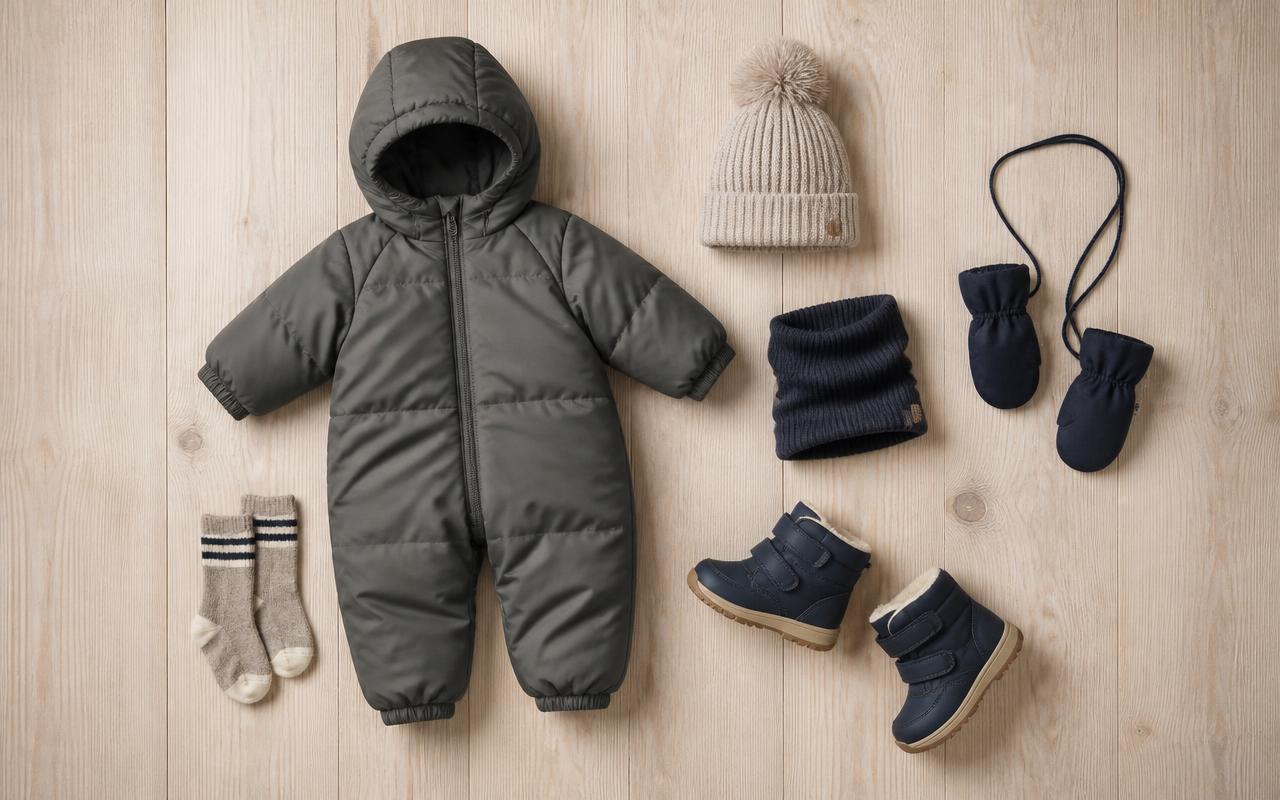
When temperatures drop, do not automatically put every warm item you own on your child. 1177 notes that children are often dressed too warmly rather than too lightly.*1
Instead, add warmth in layers. A typical winter setup might be:
Base layer → fleece/wool if needed → winter overall → winter boots → hat → mittens
If your child runs constantly, they may need less underneath. If they spend more time sitting, walking slowly or playing in snow, they may need more.
You do NOT need to buy everything new
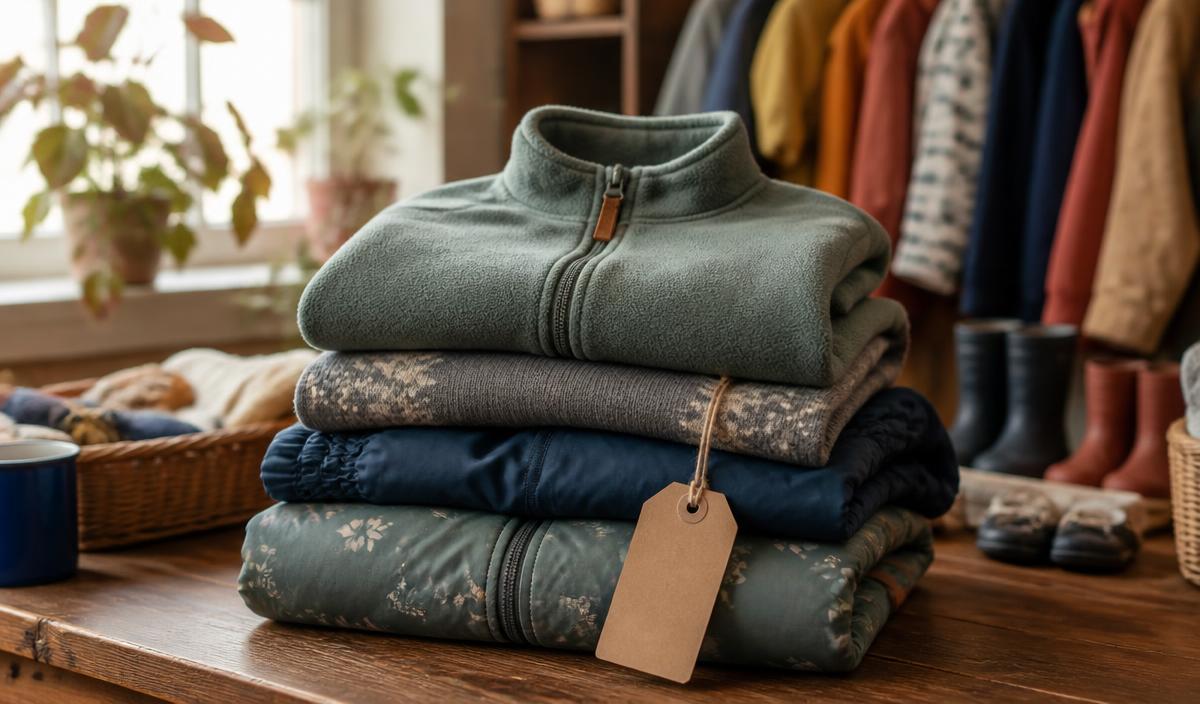
This deserves its own section, because preschool clothing can get expensive very quickly. A winter overall. Shell clothes. Rainwear. Fleece. Wool layers. Boots. Mittens. And then preschool asks you to leave spare clothes there too.
It is completely reasonable to buy good-condition second-hand clothing — and for preschool it can be particularly practical. Instead of spending your entire budget on one expensive brand-new outerwear set, you may prefer to have one good main set + one good-quality second-hand backup set, so your child still has something dry to wear when the first one is wet, muddy or waiting to be washed.
Second-hand works particularly well for outerwear, rainwear, fleece, wool layers, spare trousers and extra preschool clothes.
Where do you find it? Swedish second-hand shops like Myrorna, Röda Korset and Erikshjälpen have large children's sections, and online marketplaces such as Tradera, Blocket and Sellpy are full of kids' outdoor gear. On Facebook Marketplace and in local parenting groups, families often sell children's clothes in bundles by size — one bag of size 110 autumn clothes can cover a big part of the season.
Reusing clothes also extends their useful life. The European Environment Agency identifies longer use and reuse as ways to reduce the environmental and climate impact of textiles.*3 Even PO.P actively encourages clothes to be passed between children and operates its own second-hand programme — the company says that roughly two-thirds of its outerwear is currently used by three children or more.*4
Buying second-hand outerwear? Give it a quick check
- Does it still fit well?
- Are the knees and bottom in good condition?
- Do the zips work? Are the seams intact?
- Are the foot straps still there?
- Are reflective details visible?
- Does the rainwear still keep water out?
And of course, wash or clean pre-owned clothing appropriately before your child uses it.
Second-hand does not have to mean "worse". For preschool, two functional sets are often more useful than one perfect set you are terrified of getting muddy. And preschool *will* get it muddy. That is kind of the point.
Keep a backup at preschool
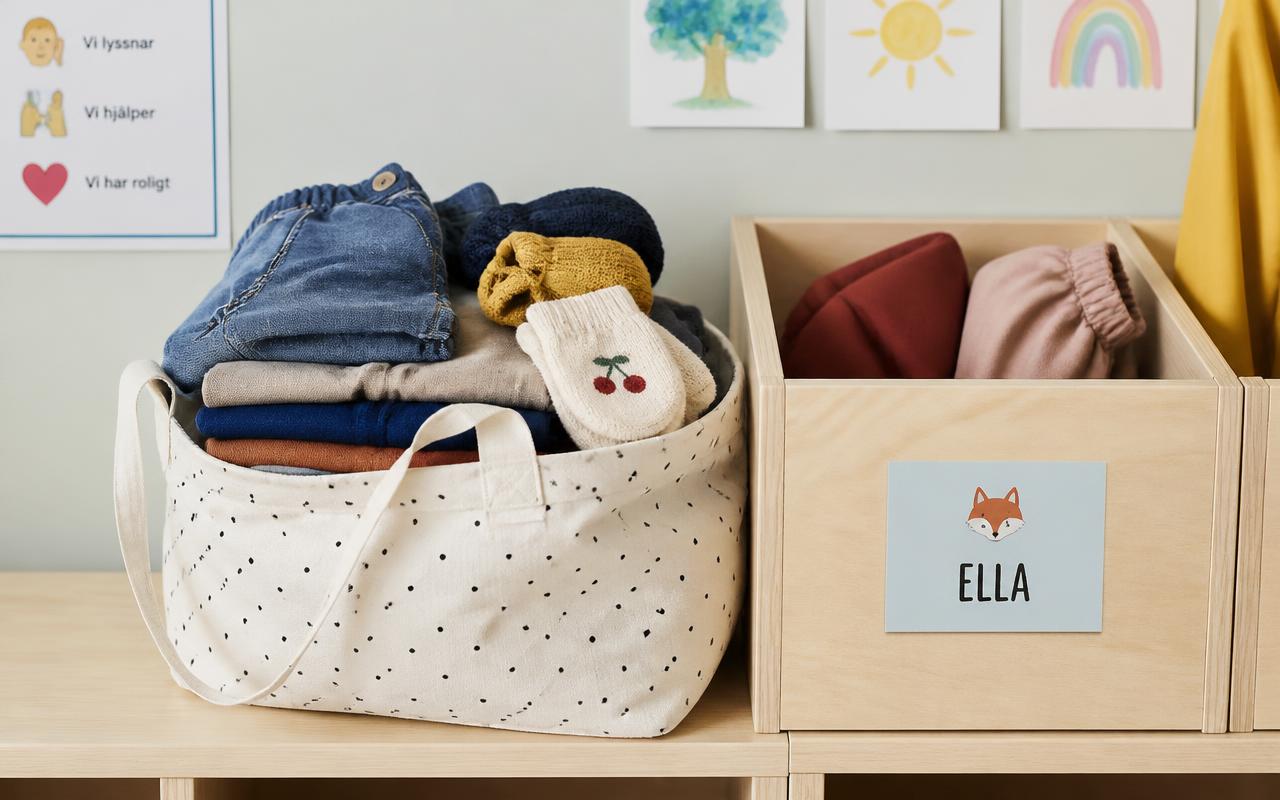
A spare outfit at preschool is not really optional once puddle season begins.
| Leave at preschool | Why |
|---|---|
| Spare trousers | Mud, water, food |
| Spare top | Same reason! |
| Underwear | Accidents happen |
| 2–3 pairs of socks | Wet feet happen a lot |
| Extra fleece/wool | Weather changes |
| Extra mittens | The first pair will eventually be wet |
| Backup rainwear/outerwear if possible | Very useful during wet seasons |
This is also where second-hand clothes are brilliant. They do not need to be Instagram-perfect — they need to be clean, comfortable, functional and the right size.
Don't forget the small things
Autumn and winter preschool life becomes significantly easier with mittens that are easy to put on, warm socks, a hat that covers the ears, a neck warmer instead of a long scarf, waterproof footwear and labelled clothes.
And label everything. Seriously. If you think your child's navy blue mitten looks unique, wait until you see twenty preschool children with navy blue mittens.
One more useful tool: PO.P's temperature guide
If you prefer something visual, Polarn O. Pyret has a very easy-to-read children's temperature guide showing different clothing combinations for changing temperatures.*5 It is particularly handy when you just want to look at the weather forecast in the morning and get a quick idea of which layers might make sense.
PO.P also makes the important point that every child is different, so the guide should be adapted to your own child's needs and situation.*5
Think of temperature charts as "start here" — not "you must dress your child exactly like this."
Before you buy half the children's department…
What to ask
How long are the children usually outside? Do you go outside in heavy rain? Do you recommend shell clothes, rainwear or both? Do you go to the forest regularly? What should stay permanently at preschool? Do you have drying cabinets?
Then buy what your child actually needs. Borrow. Accept hand-me-downs. Buy second-hand. Mix expensive pieces with cheap ones. Keep older clothes as preschool backups.
Your child does not need a brand-new wardrobe to be warm, dry and happy outside. They need functional clothes, enough layers and preferably something dry waiting when the first pair of mittens ends up inside a puddle.
Sources
- 1177: Att klä barn för att vara ute Public healthcare guidance on layers, materials, activity levels, cold weather, winter clothing and checking whether a child is too warm or cold.
- Bergans: Temperature and activity guide for children Practical clothing suggestions for 0–5°C, 6–10°C, 11–15°C and 16–18°C, while emphasising that activity level and the individual child matter.
- European Environment Agency: Environmental impacts of textiles Explains the environmental impact of textile consumption and identifies longer use, reuse and recycling among ways of reducing that impact.
- Polarn O. Pyret: Sustainability and second hand Information about extending garment life, passing children's clothes on and PO.P's own second-hand programme.
- Polarn O. Pyret: Temperature Guide A visual children's clothing guide for changing temperatures, with a reminder to adapt clothing to each individual child.
Information checked 15 September 2026. This guide is general advice, not medical advice. If you are worried about your child's health in cold weather, contact 1177 or your local vårdcentral.